Removal and Installation
Engine Assembly: Removal and Installation
WARNING:
- Situate vehicle on a flat and solid surface.
- Place chocks at front and back of rear wheels.
- For engines not equipped with engine slingers, attach proper slingers and bolts described in PARTS CATALOG.
- When lifting vehicle, ensure that the front and rear of the vehicle are well balanced.
CAUTION:
- Always be careful to work safely, avoid forceful or uninstructed operations.
- Do not start working until exhaust system and engine coolant are cooled sufficiently.
- If items or work required are not covered by the engine section, follow the procedures in the applicable sections.
- Always use the support point specified for lifting.
- Use either 2-point lift type or separate type lift. If board-on type is used for unavoidable reasons, support the rear axle jacking point with transmission jack or similar tool before starting work, in preparation for the backward shift of center of gravity.
- For supporting points for lifting and jacking point at rear axle, refer to [Lifting Point] Service and Repair.
Removal
Preparation
1) Remove front and rear engine under covers, if equipped. Refer to [Front Bumper: Removal and Installation] Service and Repair.
2) Drain engine oil. Refer to [Changing Engine Oil] Service and Repair.
3) Remove engine oil filter.
4) Drain engine coolant. Refer to [Changing Engine Coolant] Service and Repair.
5) Partially drain A/T fluid. Refer to [Changing the A/T Fluid (ATF)] Removal and Replacement.
NOTE:
Cap or plug opening(s) to prevent fluid from spilling.
6) Release fuel pressure. Refer to [Fuel Pressure Check: VQ40DE] Testing and Inspection.
7) Remove the engine hood. Refer to [Hood Assembly: Removal and Installation] Service and Repair.
8) Disconnect the battery negative terminal. Refer to [Battery: Removal and Installation] Removal and Replacement.
9) Remove engine room cover. Refer to [Engine Room Cover: Removal and Installation] Service and Repair.
10) Remove the air duct and resonator assembly and air cleaner case assembly. Refer to [Air Cleaner and Air Duct: Removal and Installation] Removal and Installation.
11) Disconnect brake booster vacuum hose between vehicle and engine and set it aside.
12) Remove front grille. Refer to [Front Grille: Removal and Installation] Service and Repair.
13) Remove the radiator assembly and hoses. Refer to [Radiator: Removal and Installation] Removal and Installation.
NOTE:
Cap or plug opening(s) to prevent fluid from spilling.
14) Remove the drive belts. Refer to [Drive Belts: Removal and Installation] Removal and Installation.
15) Remove the engine cooling fan and shroud. Refer to [Engine Cooling Fan: Removal and Installation (Crankshaft driven type)] Crankshaft Driven Type.
16) Disconnect the engine room harness from the engine side and set it aside.
17) Disconnect the engine harness grounds.
18) Reposition the reservoir tank for power steering from engine compartment and move it aside.
19) Disconnect power steering oil pump from engine. Move it from its location and secure with a rope. Refer to [Power Steering Oil Pump: Removal and Installation] Removal and Installation.
20) Remove the A/C compressor bolts and reposition the A/C compressor. Refer to [Compressor: Removal and Installation] Removal and Installation.
21) Disconnect EVAP line.
22) Disconnect the fuel hose at the engine side connection. Refer to [Fuel Injector and Fuel Tube: Removal and Installation [VQ40DE] Removal and Installation ].
NOTE:
Cap or plug opening(s) to prevent fluid from spilling.
23) Disconnect the heater hoses at cowl, and install plugs to avoid leakage of engine coolant.
NOTE:
Cap or plug opening(s) to prevent fluid from spilling.
24) Remove the A/T oil level indicator and indicator tube.
NOTE:
Cap or plug opening(s) to prevent fluid from spilling.
25) Remove front final drive assembly (4WD models). Refer to [Front Final Drive Assembly: Removal and Installation] Front Differential (R180A Type).
26) Remove three way catalyst. Refer to [Three Way Catalyst: Removal and Installation [VQ40DE] Catalytic Converter Removal and Installation ].
27) Install engine slingers into left bank and right bank.
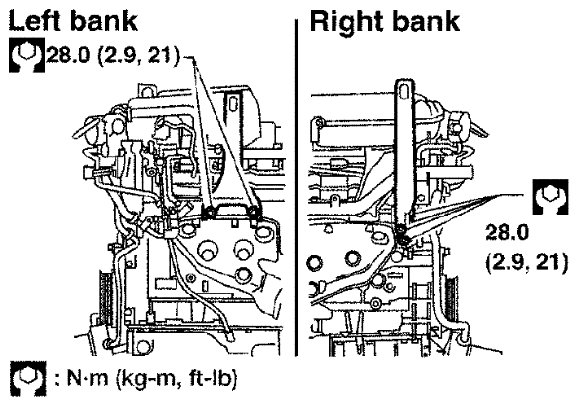

28) Remove front frame crossmember.
29) Remove transmission. Refer to [Transmission Assembly: Removal and Installation from Vehicle (For 2WD Models)] Transmission Assembly Removal and Installation from Vehicle (For 2WD Models) (2WD M/T models) [Transmission Assembly: Removal and Installation from Vehicle (For 4WD Models)] Transmission Assembly Removal and Installation from Vehicle (For 4WD Models) (4WD M/T models), [Transmission Assembly: Removal and Installation for VQ40DE 2WD Models] Removal and Installation for VQ40DE 2WD Models (2WD A/T models), [Transmission Assembly: Removal and Installation for VQ40DE 4WD Models] Removal and Installation for VQ40DE 4WD Models (4WD A/T models).
30) Remove engine mounting insulator bracket (upper) with power tool.
31) Lift with hoist and secure the engine in position.
32) Remove engine mount bracket bolts.
33) Remove engine assembly from vehicle, avoiding interference with vehicle body.
CAUTION:
- Before and during this lifting, always check if any harnesses are left connected.
34) Remove the parts that may restrict installation of engine to engine stand.
NOTE:
The procedure is described assuming that you use a engine holding the surface, to which transmission is installed.
a) Remove clutch cover and clutch disc (M/T models). Refer to [Clutch Disc, Clutch Cover: Removal and Installation [6M/T] Removal and Installation ].
b) Remove flywheel (M/T models) or drive plate (A/T models).
- Holding crankshaft pulley bolts, lock crankshaft to remove flywheel or drive plate bolts.
- Loosen bolts diagonally.
CAUTION:
- Be careful not to damage or scratch drive plate (A/T models) and contact surface for clutch disc of flywheel (M/T models). Especially avoid deforming and damaging of signal plate teeth (circumference position).
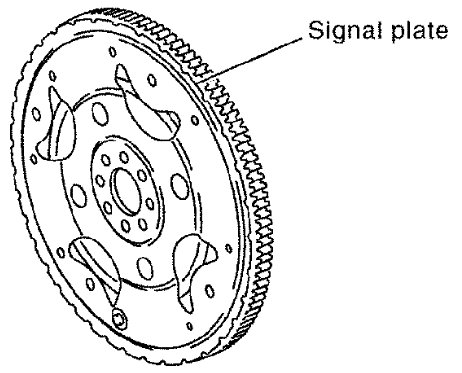
- Do not disassemble drive plate.
- Place the drive plate with signal plate surface facing other than downward.
- Keep magnetic materials away from signal plate.
CAUTION:
Use an engine stand that has a load capacity [approximately 240kg (529 lb) or more] large enough for supporting the engine weight.
- If the load capacity of the stand is not adequate, remove the following parts beforehand to reduce the potential risk of overturning the stand.
- Remove fuel tube and fuel injector assembly. Refer to [Fuel Injector and Fuel Tube: Removal and Installation [VQ40DE]] Removal and Installation.
- Remove intake manifold. Refer to [Intake Manifold: Removal and Installation] Intake Manifold Removal and Installation.
- Remove rocker cover. Refer to [Rocker Cover: Removal and Installation] Removal and Installation.
- Other removable brackets.
CAUTION:
Before removing the hanging chains, make sure the engine stand is stable and there is no risk of overturning.
Installation
Installation is in the reverse order of removal.
CAUTION:
- When replacing an engine or transmission you must make sure the dowels are installed correctly during reassembly.
- Improper alignment caused by missing dowels may cause vibration, oil leaks or breakage of drivetrain components.
Inspection after Installation
- Before starting engine, check oil/fluid levels including engine coolant and engine oil. If less than required quantity, fill to the specified level. Refer to [Recommended Fluids and Lubricants [for USA and Canada] [1][2]Maintenance ] (United States and Canada). Refer to [Recommended Fluids and Lubricants [for Mexico] [1][2]Maintenance ] (Mexico).
- Use procedure below to check for fuel leakage.
- Turn ignition switch ON (with engine stopped). With fuel pressure applied to fuel piping, check for fuel leakage at connection points.
- Start engine. With engine speed increased, check again for fuel leakage at connection points.
- Run engine to check for unusual noise and vibration.
NOTE:
If hydraulic pressure inside timing chain tensioner drops after removal and installation, slack in the guide may generate a pounding noise during and just after engine start. However, this is normal. Noise will stop after hydraulic pressure rises.
- Warm up engine thoroughly to make sure there is no leakage of fuel, exhaust gas, or any oils/fluids including engine oil and engine coolant.
- Bleed air from passages in lines and hoses, such as in cooling system.
- After cooling down engine, again check oil/fluid levels including engine oil and engine coolant. Refill to specified level, if necessary.
- Summary of the inspection items:
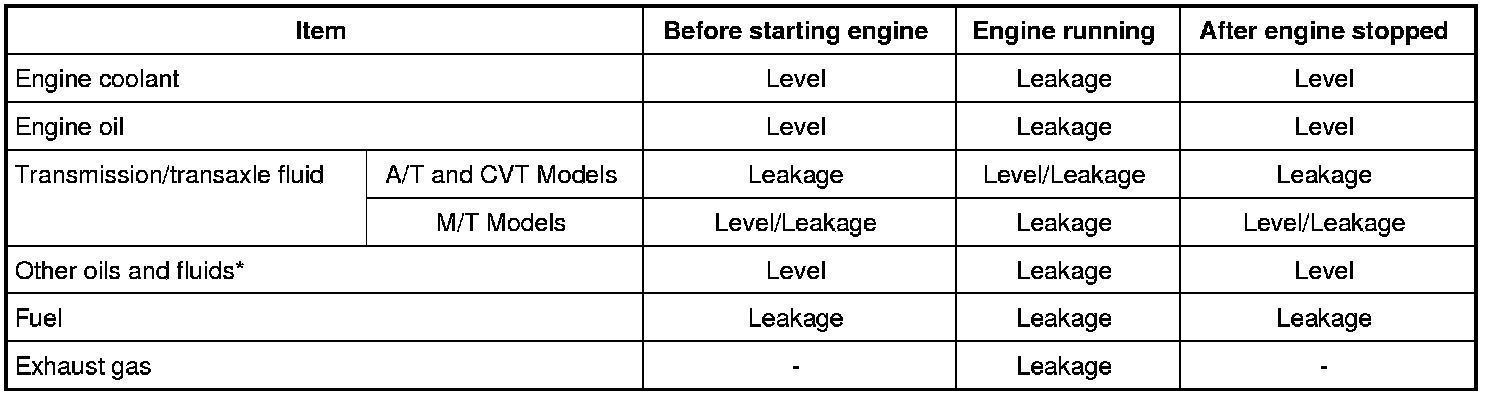
*Power steering fluid, brake fluid, etc.