Removal and Installation
Oil Cooler: Removal and Installation
WARNING:
- Be careful not to burn yourself, as the engine oil and engine coolant may be hot.
CAUTION:
- Do not spill engine coolant on the drive belts.
- Do not spill engine oil on rubber parts such as drive belts and engine mounting insulator.
Removal
NOTE:
When removing oil cooler only, step 1 is unnecessary.
1) Drain engine coolant from radiator drain plug at the bottom of radiator and from water drain plug on cylinder block. Refer to [Changing Engine Coolant] Service and Repair and [Engine Unit: Exploded View] Exploded View.
NOTE:
Perform this step only when removing water hoses.
NOTE:
Cap or plug opening(s) to prevent fluid from spilling.
2) Disconnect water hoses from oil cooler, pinching water hoses near oil cooler to prevent engine coolant spilling.
CAUTION:
Perform this step when engine is cold.
NOTE:
Cap or plug opening(s) to prevent fluid from spilling.
3) Remove oil filter. Refer to [Oil Filter: Removal and Installation] Service and Repair.
4) Remove water hoses, brackets and water connector, as necessary.
NOTE:
Cap or plug opening(s) to prevent fluid from spilling.
5) Remove connector bolt, and remove oil cooler.
Inspection after Removal
Oil Cooler
Check oil cooler for cracks. Check oil cooler for clogging by blowing compressed air through engine coolant inlet. If necessary, replace oil cooler assembly.
Relief Valve
Check relief valve for movement, cracks and breaks by pushing the ball. If replacement is necessary, remove valve by prying it out using a suitable tool. Install the new valve in place by tapping it in.
Installation
Installation is in the reverse order of removal, paying attention to the following.
- Confirm that no foreign objects are adhering to the sealing surfaces of the oil cooler and lower cylinder block.
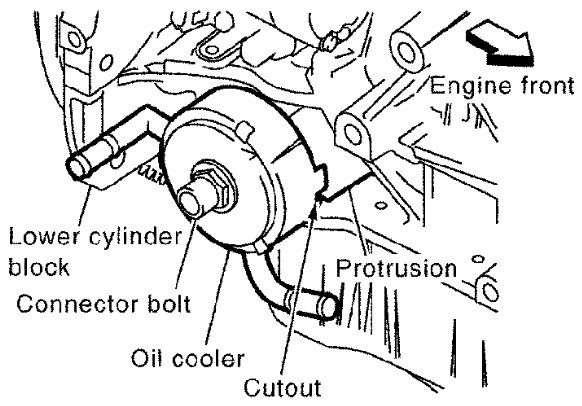
- Align cutout on oil cooler with protrusion on lower cylinder block side, and tighten connector bolt.
Inspection after Installation
- Before starting engine, check oil/fluid levels including engine coolant and engine oil. If less than required quantity, fill to the specified level. Refer to [Recommended Fluids and Lubricants [for USA and Canada] [1][2]Maintenance ].
- Use procedure below to check for fuel leakage.
- Turn ignition switch ON (with engine stopped). With fuel pressure applied to fuel piping, check for fuel leakage at connection points.
- Start engine. With engine speed increased, check again for fuel leakage at connection points.
- Run engine to check for unusual noise and vibration.
NOTE:
If hydraulic pressure inside timing chain tensioner drops after removal and installation, slack in the guide may generate a pounding noise during and just after engine start. However, this is normal. Noise will stop after hydraulic pressure rises.
- Warm up engine thoroughly to make sure there is no leakage of fuel, exhaust gas, or any oils/fluids including engine oil and engine coolant.
- Bleed air from passages in lines and hoses, such as in cooling system.
- After cooling down engine, again check oil/fluid levels including engine oil and engine coolant. Refill to specified level, if necessary.
- Summary of the inspection items:
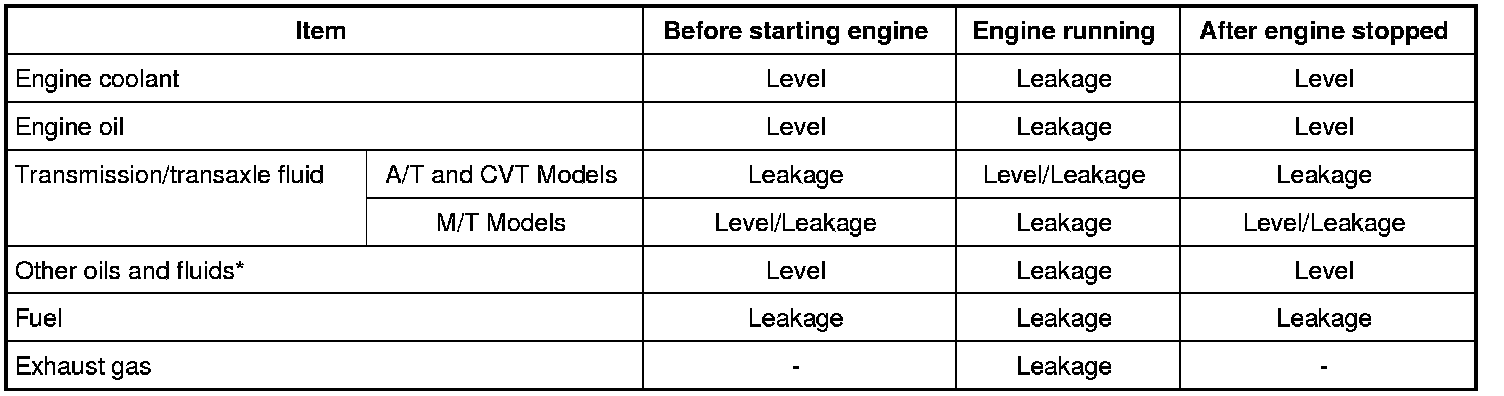
*Power steering fluid, brake fluid, etc.