Thermostat
Thermostat: Removal and Installation
WARNING:
Never remove the radiator cap when the engine is hot. Serious burns could occur from high pressure engine coolant escaping from the radiator. Wrap a thick cloth around the cap. Slowly turn it a quarter of a turn to release built-up pressure. Carefully remove radiator cap by turning it all the way.
Removal
1) Drain engine coolant from the radiator. Refer to [Changing Engine Coolant] Service and Repair and [Engine Unit: Exploded View] Exploded View.
CAUTION:
- Perform this step when the engine is cold.
- Do not spill engine coolant on drive belt.
2) Remove the air duct. Refer to [Air Cleaner and Air Duct: Exploded View] Exploded View.
3) Disconnect radiator hose (lower) at water inlet side. Refer to [Radiator: Exploded View] Exploded View.
4) Remove water inlet, O-ring and thermostat.
CAUTION:
Discard O-ring, do not reuse.
Inspection after Removal
- Place a thread so that it is caught in the valve of the thermostat. Immerse fully in a container filled with water. Heat while stirring.
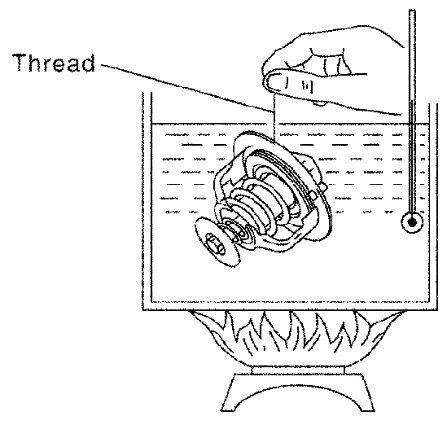
- The valve opening temperature is the temperature at which the valve opens and falls from the thread.
- Continue heating. Check the full-open lift amount.
NOTE:
The full-open lift amount standard temperature for water control valve is the reference value.
- After checking the full-open lift amount, lower the water temperature and check the valve closing temperature.
Standard:

- If out of the standard, replace thermostat.
Installation
Installation is in the reverse order of removal.
- Apply a mild soap to a new O-ring before inserting heater pipe end into water pump and thermostat housing. Then insert it immediately.
Thermostat
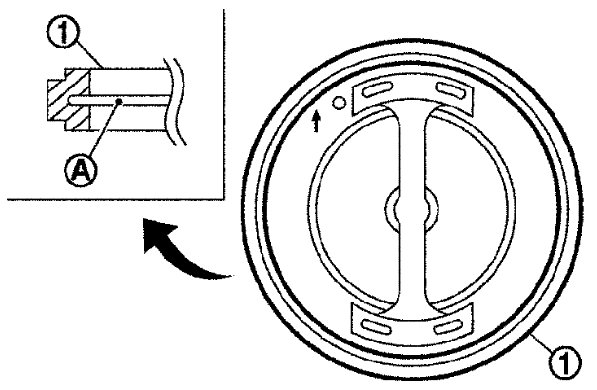
- Install thermostat by making rubber ring (1) groove fit to thermostat flange (A) around the whole circumference.
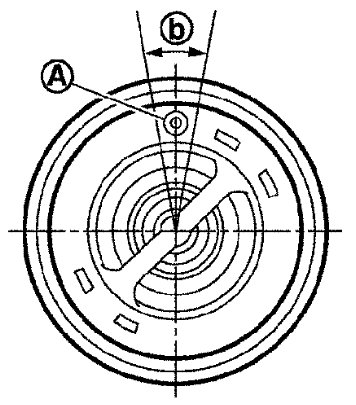
- Install thermostat with jiggle valve (A) facing upward. The position may deviate within the range of 20° (b).
Inspection after Installation
- Check for engine coolant leaks. Refer to [Engine Coolant: System Inspection] Initial Inspection and Diagnostic Overview.
- Start and warm up the engine. Visually check for engine coolant leaks. Repair as necessary.