Engine and Emission Control System Check
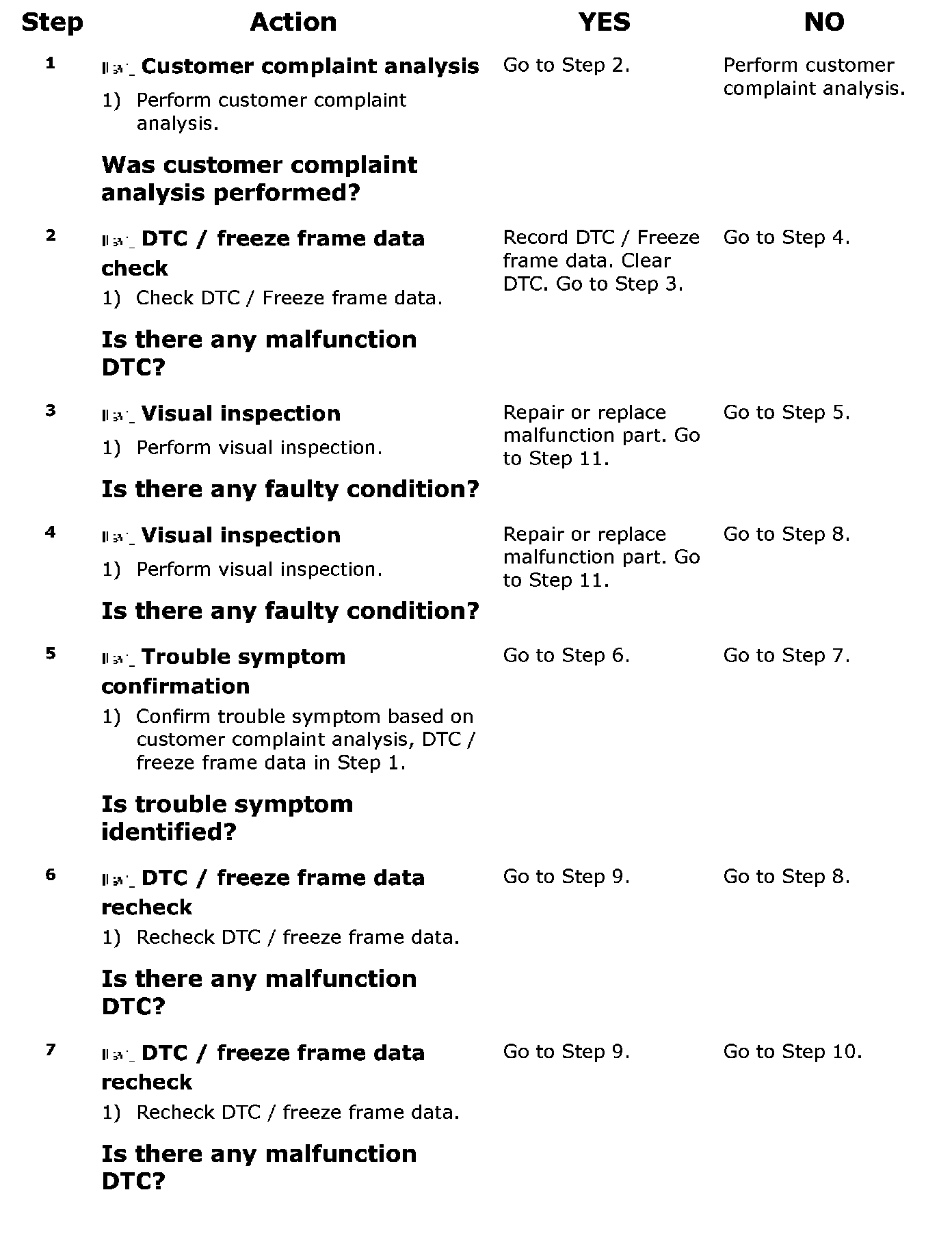
Engine and Emission Control System CheckStep 1 - 7:
Step 8 - 11:
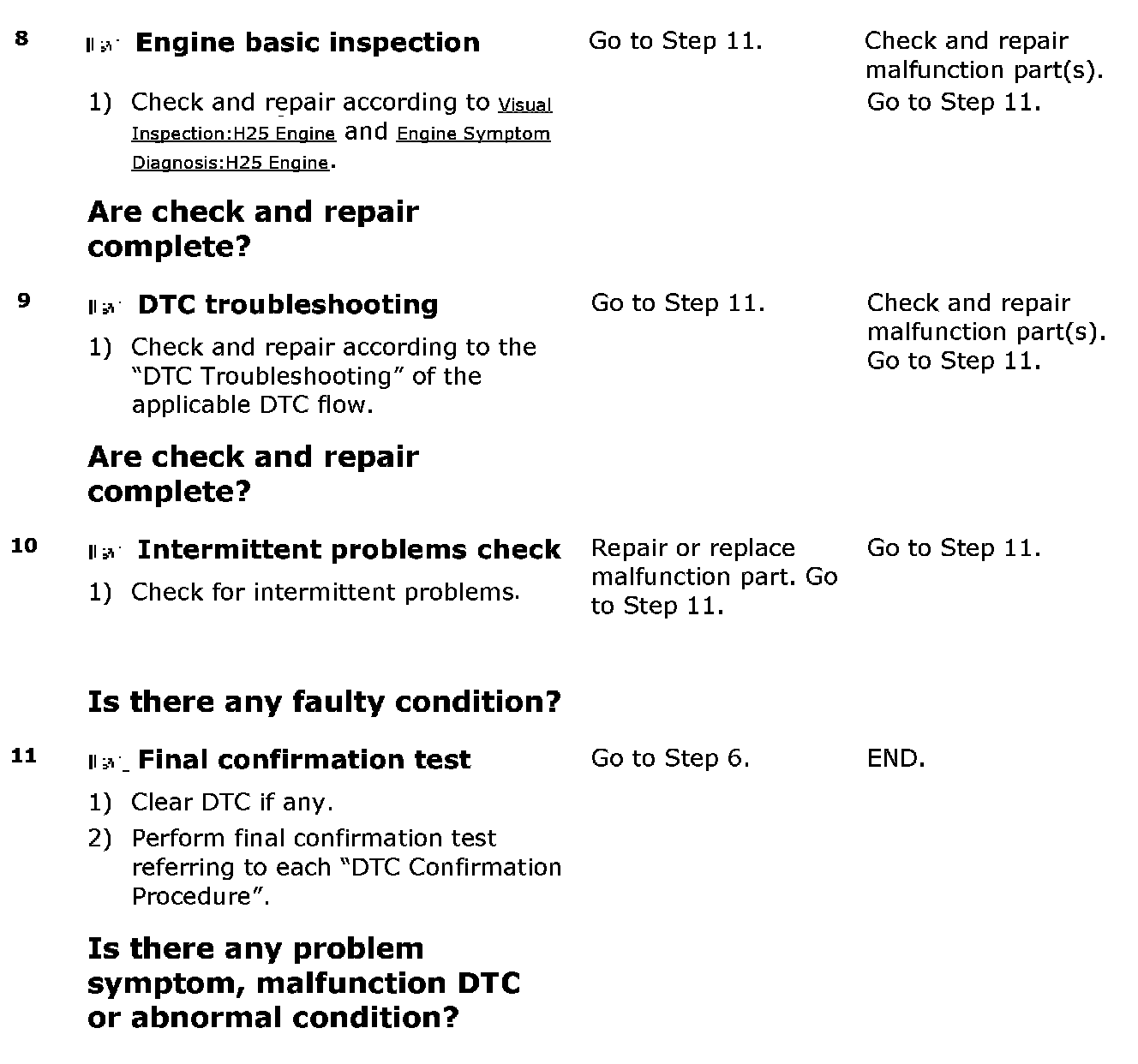
Numbers of each step correspond to the numbers of the items after this table.
Refer to the items for the detail of each step.
Description for Each Step
Step 1: Customer complaint analysis
Customer Problem Inspection Form (Example):
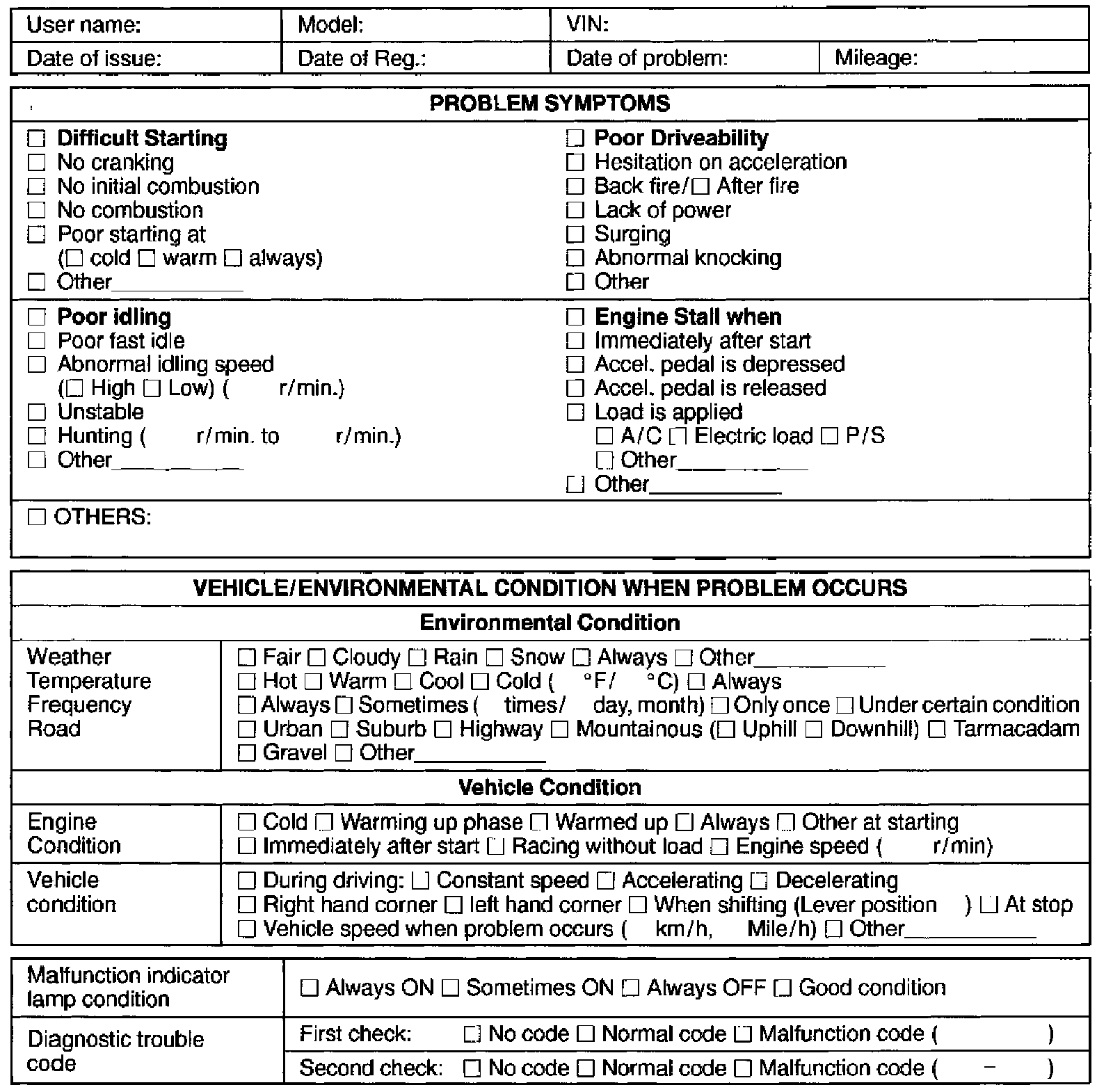
Record details of the problem (failure, complaint) and how it occurred as described by the customer. For this purpose, use of such an inspection form will facilitate collecting information to the point required for proper analysis and diagnosis.
NOTE: The form is standard sample. It should be modified according to conditions and characteristics of each market.
Step 2: DTC / freeze frame data check
First, check DTC, If DTC is indicated, record DTC and freeze frame data. After that clear DTC, DTC indicates malfunction that occurred in the system but does not indicate whether it exists now or it occurred in the past and the normal condition has been restored now. To check which case applies, check the symptom in question according to Step 5 and recheck DTC according to Step 6 and 7. Attempt to diagnose a trouble based on DTC in this step only or failure to clear the DTC (including pending DTC) in this step will lead to incorrect diagnosis, trouble diagnosis of a normal circuit or difficulty in troubleshooting.
NOTE:
- If any DTC P0461 (Fuel level sensor circuit performance problem) is indicated in this step, perform visual inspection according to Step 3 and then proceed to DTC P0461: Fuel Level Sensor Circuit Performance:H25 Engine.
- For A/T vehicle, if only DTC P0705, P0707, P0717, P0722, P0741, P0742, P0741, P0751, P0752, P0756, P0757, P0973, P0974, P0976, P0977, P1740, P1875, P2769 or P2770 is indicated in this step, proceed to A/T System Check:4 A/T.
Step 3 and 4: Visual inspection
Be sure to perform visual check that support proper function of the engine.
Step 5: Trouble symptom confirmation
Based on information obtained in "Customer complaint analysis" and "DTC / freeze frame data check", confirm trouble symptoms. Also, reconfirm DTC according to "DTC Confirmation Procedure" described in each diag. flow.
Step 6 and 7: DTC / freeze frame data check
Refer to DTC Check:H25 Engine or checking procedure.
Step 8: Engine basic inspection
Perform basic engine check according to the Visual Inspection:H25 Engine first. When the end of the flow has been reached, check the parts of the system suspected as a possible cause and based on symptoms appearing on the vehicle (symptoms obtained through steps of customer complaint analysis, trouble symptom confirmation and/or basic engine check) and repair or replace faulty parts, if any. (See Engine Basic Check:H25 Engine.)
Step 9: DTC troubleshooting
Based on the DTC indicated in Step 6 or 7 and referring to each "DTC Troubleshooting" of the applicable DTC, locate the cause of the trouble, namely in a sensor, switch, wire harness, connector, actuator, ECM (PCM) or other part and repair or replace faulty parts.
Step 10: Intermittent problems check
Check parts where an intermittent trouble is easy to occur (e.g., wire harness, connector, etc.) and related circuit of DTC recorded in Step 2.
Step 11: Final confirmation test
Confirm that the problem symptom has gone and the engine is free from any abnormal conditions. If what has been repaired is related to the DTC, clear the DTC once, perform DTC confirmation procedure and confirm that no malfunction DTC (a normal code) is indicated.