Flow of Diagnosis
ABS Diagnosis IntroductionTo ensure that the trouble diagnosis is done accurately and smoothly, observe "Precautions in Diagnosing Troubles (for ABS): Type 1" and follow "ABS Check: Type 1" or "ABS Check: Type 2".
ABS Check
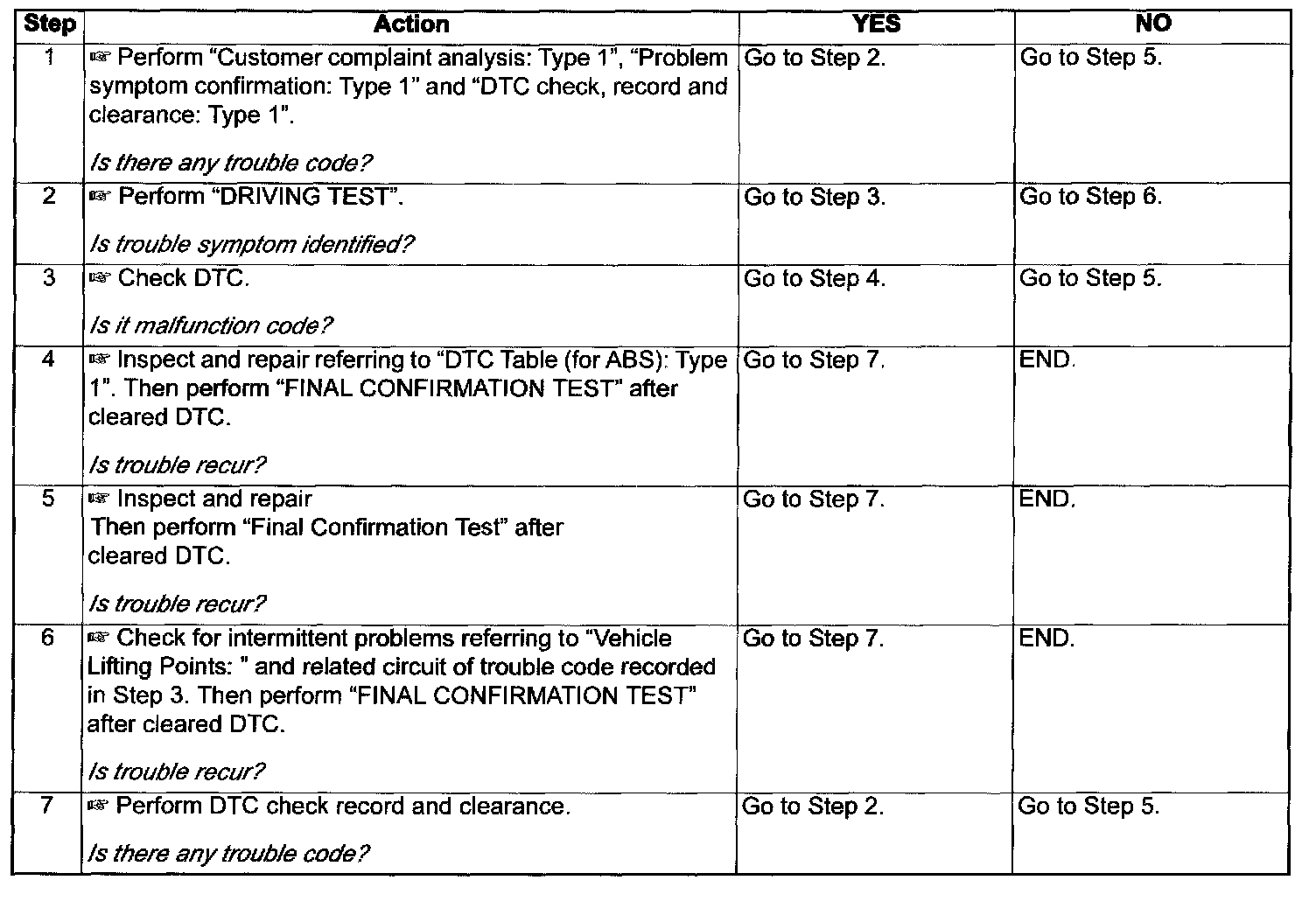
Refer to the following items for the details of each step.
Step 1: Malfunction Analysis
Customer complaint analysis
Record details of the problem (failure, complaint) and how it occurred as described by the customer.
For this purpose, use of such a questionnaire form as shown will facilitate collecting information to the point required for proper analysis and diagnosis.
CUSTOMER QUESTIONNAIRE (EXAMPLE)

Part 1 of 2
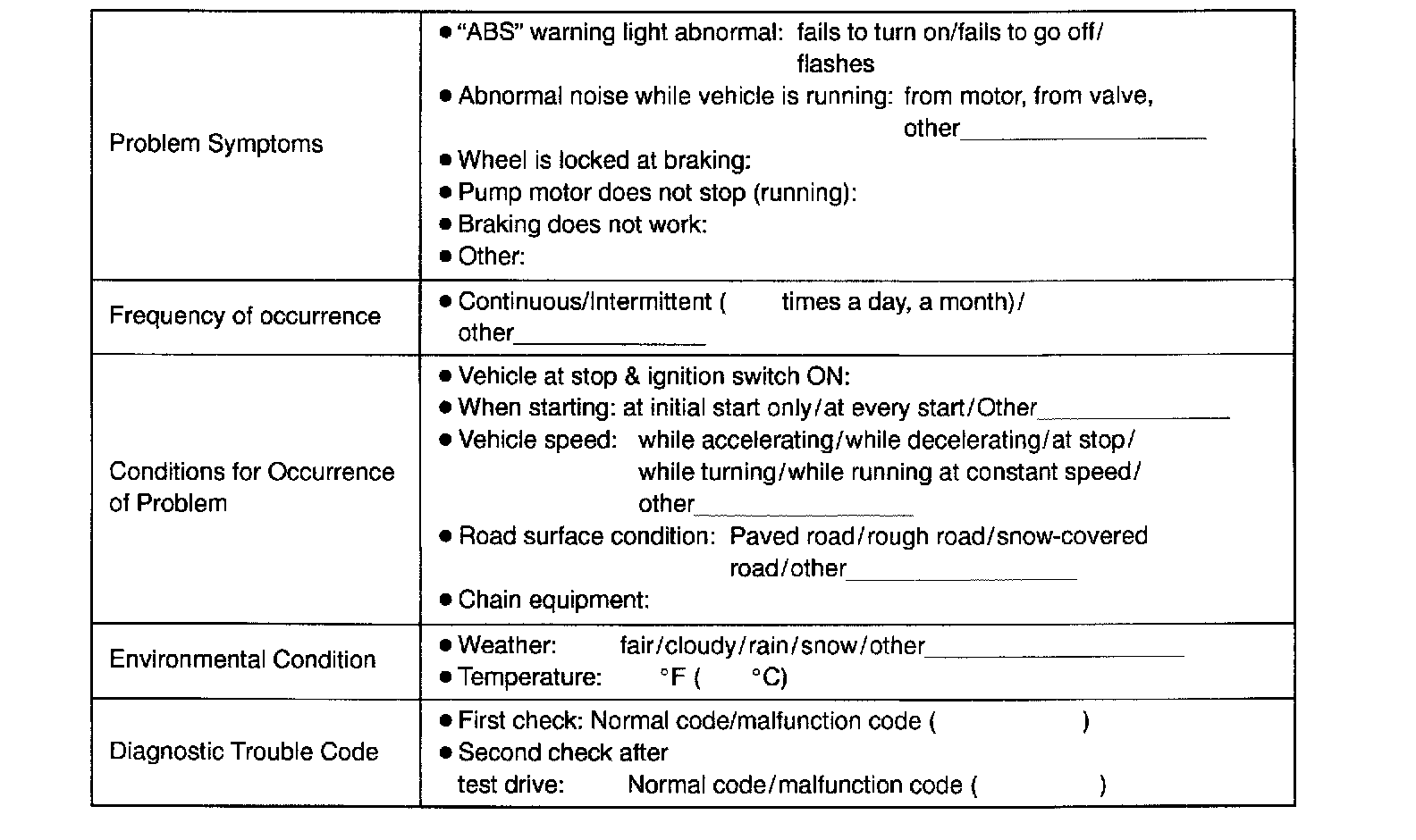
Part 2 of 2
Problem symptom confirmation
Check if what the customer claimed in CUSTOMER QUESTIONNAIRE is actually found in the vehicle and if that symptom is found, whether it is identified as a failure. (This step should be shared with the customer if possible.) When "ABS" warning light is not operated correctly, proceed to "ABS Warning Light Inoperative, No DTC(s) Stored: Type 1" or "ABS Warning Light On, No DTC(s) Stored: Type 1".
DTC check, record and clearance
Perform "DTC Check" as shown, record it and then clear it.
If the malfunction DTC which was once displayed and then cleared cannot be detected (indicated) again when the ignition switch is turned ON position, attempt to diagnose the trouble based on the DTC recorded in this step may mislead the diagnosis or make diagnosing difficult. Proceed to Step 2 to check EBCM for proper self-diagnosis function.
If the malfunction DTC which was once displayed and then cleared can be detected (indicated) again when ignition switch is turned to ON position, proceed to Step 3.
Step 2: Driving Test
Test drive the vehicle at 40 km/h for more than a minute and check if any trouble symptom (such as abnormal lighting of "ABS" warning light) exists.
If the malfunction DTC is confirmed again at ignition switch ON position, driving test as described in above is not necessary. Proceed to Step 3.
Step 3: DTC Check
Recheck DTC.
Step 4: DTC Flow
According to Diagnostic flow for the DTC confirmed in Step 3, locate the cause of the trouble, namely in a sensor, switch, wire harness, connector, actuator assembly or other part and repair or replace faulty parts.
Step 5: Brakes Diagnosis
Check the parts or system suspected as a possible cause and based on symptoms appearing on the vehicle (symptoms obtained through "Customer complaint analysis: Type 1", "Problem symptom confirmation: Type 1" and "DRIVING TEST" and repair or replace faulty parts, if any.
Step 6: Check for Intermittent Problem
Check parts where an intermittent trouble is easy to occur (e.g., wire harness, connector, etc.).
Step 7: Final Confirmation Test
Confirm that the problem symptom has gone and the ABS is free from any abnormal conditions. If what has been repaired is related to the malfunction DTC, clear the DTC once and perform test driving and confirm that no DTC is indicated.