Shift Solenoid: Service and Repair
REMOVAL1. Pull out dipstick and lift up vehicle.
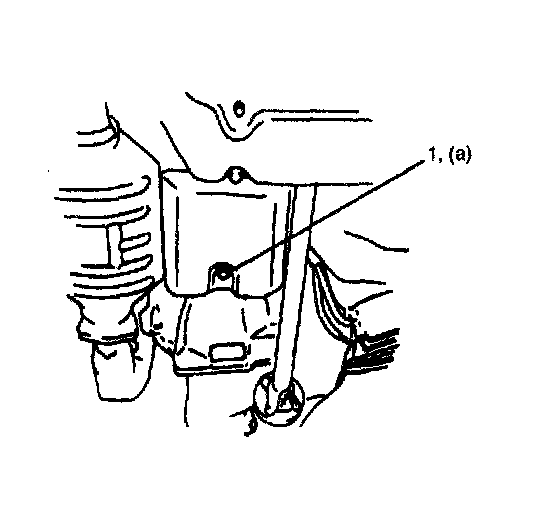
2. With engine cooled, remove drain plug (1) from oil pan and drain A/T fluid.
3. Install drain plug (1) with gasket.
Tightening torque
A/T fluid drain plug (a): 23 Nm, (2.3 kg-m, 17.0 ft. lbs.)
4. Remove exhaust pipe bracket and disconnect front propeller shaft from front differential (if equipped).
5. Remove oil pan bolts.
6. Remove oil pan.
7. Remove oil tubes.
8. Remove solenoid valve No.1 (shift solenoid valve A and B) or solenoid valve No.2 (TCC solenoid valve).
OPERATION CHECK
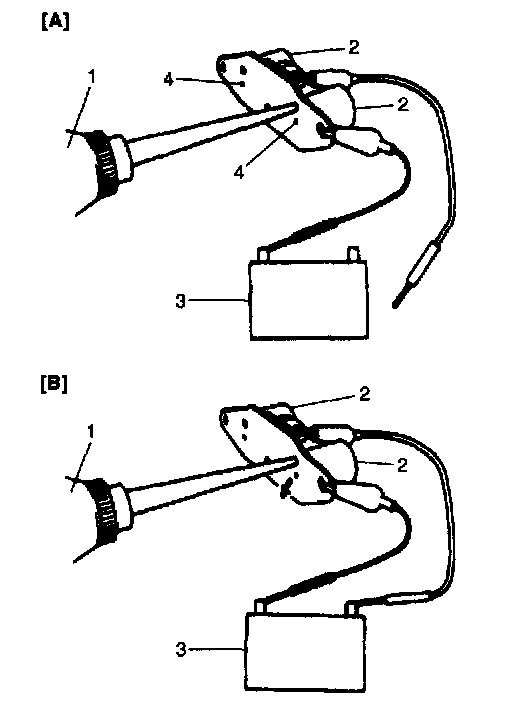
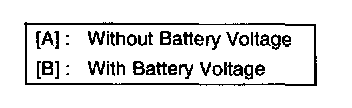
Whenever shift solenoid valves and TCC (lock-up) solenoid valve are removed from transmission, verify their valve function physically before they are reinstalled.
1. Apply oiler (1) to solenoid valve (2) and give compression by hands and then check to be sure that transmission fluid from oiler (1) does not come out of holes (4) in solenoid valve (2) when battery (3) voltage is not conducted.
2. Under the same conditions, conduct battery (3) voltage and then make sure that fluid comes out with vigor.
NOTE:
^ If fluid does not come out with vigor in step 2 inspection, do not re-use that solenoid valve (2).
^ Figure at the left shows shift solenoid valve (2) check. Check TCC solenoid valve also in the same way.
INSTALLATION
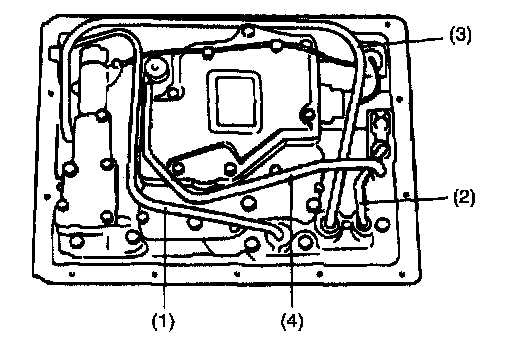
Reverse removal procedure to install solenoid valves and noting the following points.
^ For details of solenoid valve installation, refer to "UNIT REPAIR". Use new gasket and O-ring.
^ Install oil tubes in such order as shown in the figure.
^ For details of oil pan installation, refer to "UNIT REPAIR". Use new oil pan gasket.
^ Tighten universal joint flange bolts & nuts and exhaust pipe bracket bolts to specified torque.
^ Fill A/T fluid and check fluid level.
^ Check for fluid leakage after warming up A/T.