Diagnosis & Repair Procedure
- Perform DTC CONFIRMATION TEST . If DTC P0440 or P0455 is set, go to next step. If DTC P0440 and P0455 are not set, problem is intermittent. System is okay at this time. See TROUBLE SHOOTING - NO CODES article.
- Ensure fuel filler cap is original equipment. Check fuel filler cap for tightness. Check fuel filler cap gasket for proper sealing. Tighten cap or replace as necessary and go to DTC CONFIRMATION TEST . If fuel filler cap is okay, go to next step.
- Check vacuum hoses for proper connection, leakage, plugging, and deterioration. If problem exists, repair as necessary and go to DTC CONFIRMATION TEST . If problem does not exist, go to next step.
- Ensure transmission is in Park (A/T) or Neural (M/T) and parking braking brake is on. Turn ignition off. Allow engine to cool. Disconnect purge hose from EVAP canister purge line next to EVAP canister purge valve. See Figure. Start engine and allow it to idle. Place finger over end of disconnected hose. Vacuum should not be present. Reconnect purge hose to EVAP canister purge line. Allow engine to reach normal operating temperature. Disconnect purge hose from EVAP canister purge line. Place finger over end of disconnected hose. Vacuum should be present. If results are not as specified, go to next step. If results are as specified, go to step 6.
- Check EVAP canister purge valve and circuit operation. See FUEL EVAPORATION in SYSTEM & COMPONENT TESTING article. If EVAP canister purge valve and circuit are okay, go to next step. If EVAP canister purge valve and circuit are not as specified, check for plugged vacuum passage. If vacuum passage is okay, go to step 16.
- Check operation of Fuel Tank Pressure Control Valve (FTPCV) and circuit. See SYSTEM & COMPONENT TESTING article. If FTPCV and circuit are okay, go to next step. If FTPCV or circuit are not okay, go to step 18.
- Check EVAP canister air valve and circuit operation. See SYSTEM & COMPONENT TESTING article. If EVAP canister air valve and circuit are okay, go to next step. If EVAP canister air valve or circuit is not okay, go to step 20.
- Disconnect EVAP canister purge hose from EVAP canister purge valve. Disconnect and plug EVAP canister air hose. Backprobing, connect a fused jumper wire between ground and PCM 26-pin connector C21 terminal No. 16 (Light Green/Red wire). Using scan tool, observe fuel tank pressure while applying 1.03 in. Hg. of vacuum to disconnect end of EVAP canister purge hose. Hold for 15 seconds. Go to next step.
- Check vacuum. If vacuum does not hold above 0.97 in. Hg., check for leak in EVAP system. If EVAP system is okay, go to next step. If vacuum holds above 0.97 in. Hg., check for leaks in vapor purge hose, fuel filler cap and fuel filler neck. If components are okay, remove fuel tank. See REMOVAL, OVERHAUL & INSTALLATION article. Check for leaks at fuel tank component mounting arias, hose joints, fuel tank pressure control valve and refuel vapor control valve. If no problem is found, go to next step.
- Check fuel level sensor and its circuit. See DTC P0461: POOR FUEL LEVEL SENSOR CIRCUIT PERFORMANCE . Repair or replace as necessary. Go to DTC CONFIRMATION TEST . If system operates as specified, go to next step. If vehicle is equipped with tachometer also check short to ground in Black/Blue wire between PCM 22-pin connector C23 terminal No. 9 and instrument cluster 16-pin connector G15 terminal No. 4. See Figure and Figure
. See WIRING DIAGRAMS article. Repair as necessary and go to DTC CONFIRMATION TEST .
- Inspect EVAP canister for damage or plugging. See Fig 1. See EVAP CANISTER under FUEL EVAPORATION in SYSTEM & COMPONENT TESTING article. Replace as necessary and go to DTC CONFIRMATION TEST . If EVAP canister is okay, go to next step.
- Check fuel tank pressure sensor operation. See DTC P0450: EVAP SYSTEM PRESSURE SENSOR MALFUNCTION . Repair or replace as necessary and go to DTC CONFIRMATION TEST . If fuel tank pressure sensor is okay, go to next step.
- Check operation of FTPCV. See SYSTEM & COMPONENT TESTING article. Replace as necessary and go to DTC CONFIRMATION TEST . If FTPCV is okay, go to next step.
- Check EVAP canister air valve. See SYSTEM & COMPONENT TESTING article. Replace as necessary and go to DTC CONFIRMATION TEST . If EVAP canister air valve is okay, go to next step.
- Check for plugged EVAP system hoses connected to fuel tank. Repair as necessary and go to DTC CONFIRMATION TEST . If hoses are okay, problem is probably intermittent. System may be okay at this time. See TROUBLE SHOOTING - NO CODES article. If intermittent problem is not found, replace PCM and go to DTC CONFIRMATION TEST .
- Check EVAP canister purge valve operation. See SYSTEM & COMPONENT TESTING article. Replace as necessary and go to DTC CONFIRMATION TEST . If EVAP canister purge valve is okay, check for short or open in White/Blue wire between EVAP canister purge valve, main relay and PCM 26-pin connector C21 terminals No. 2 and No. 15. Go to next step.
- Also check for short or open in Red/Green wire between EVAP canister purger valve and PCM 26-pin connector C21 terminal No. 7. Repair as necessary and go to DTC CONFIRMATION TEST . If wires are okay, replace PCM and go to DTC CONFIRMATION TEST .
- Check operation of FTPCV. See FUEL TANK PRESSURE CONTROL VALVE under FUEL EVAPORATION in SYSTEM & COMPONENT TESTING article. Repair as necessary. If FTPCV is okay, check for short or open in White/Blue wire between FTPCV, main relay and PCM 26-pin connector C21 terminals No. 2 and No. 15. Go to next step.
- Also check for short or open in circuit between FTPCV connector terminal No. 2 (Yellow wire) and PCM 26-pin connector C21 terminal No. 16 (Light Green/Red wire). Repair as necessary and go to DTC CONFIRMATION TEST . If wires are okay, replace PCM and go to DTC CONFIRMATION TEST .
- Check EVAP canister air valve operation. See SYSTEM & COMPONENT TESTING article. Replace as necessary and go to DTC CONFIRMATION TEST . If EVAP canister air valve is okay, check for short or open in White/Blue wire between EVAP canister air valve, main relay and PCM 26-pin connector C21 terminals No. 2 and No. 15. Go to next step.
- Also check for short or open in circuit between EVAP canister air valve connector terminal No. 1 (Red Green wire) and PCM 26-pin connector C21 terminals No. 3 (Pink/Blue wire). Repair as necessary and go to DTC CONFIRMATION TEST . If wires are okay, replace PCM and go to DTC CONFIRMATION TEST .
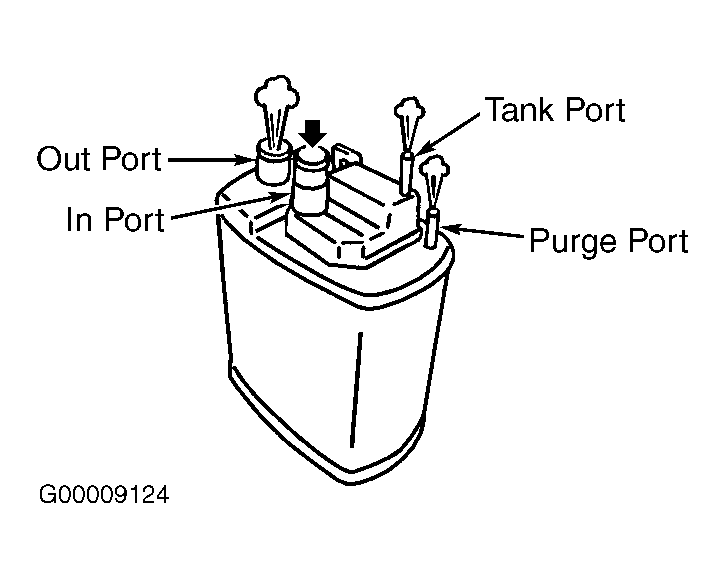 Courtesy of SUZUKI OF AMERICA CORP.