ABS Light: Description and Operation
ABS Warning Light
The EBCM continuously monitors itself and the other ABS components. If the EBCM detects a problem with the system, the amber "ABS" warning light will either light or flash continuously to alert the driver of the problem.
A solid "ABS" warning light indicates that a problem has been detected that affects the operation of ABS. No anti-lock braking will be available. Normal, non-antilock brake performance will remain. In order to regain ABS braking ability, the ABS must be serviced.
ABS ACTIVE Light

The blue "ABS ACTIVE" light identifies when the system is working to provide antilock braking.
INDICATOR LIGHT OPERATION
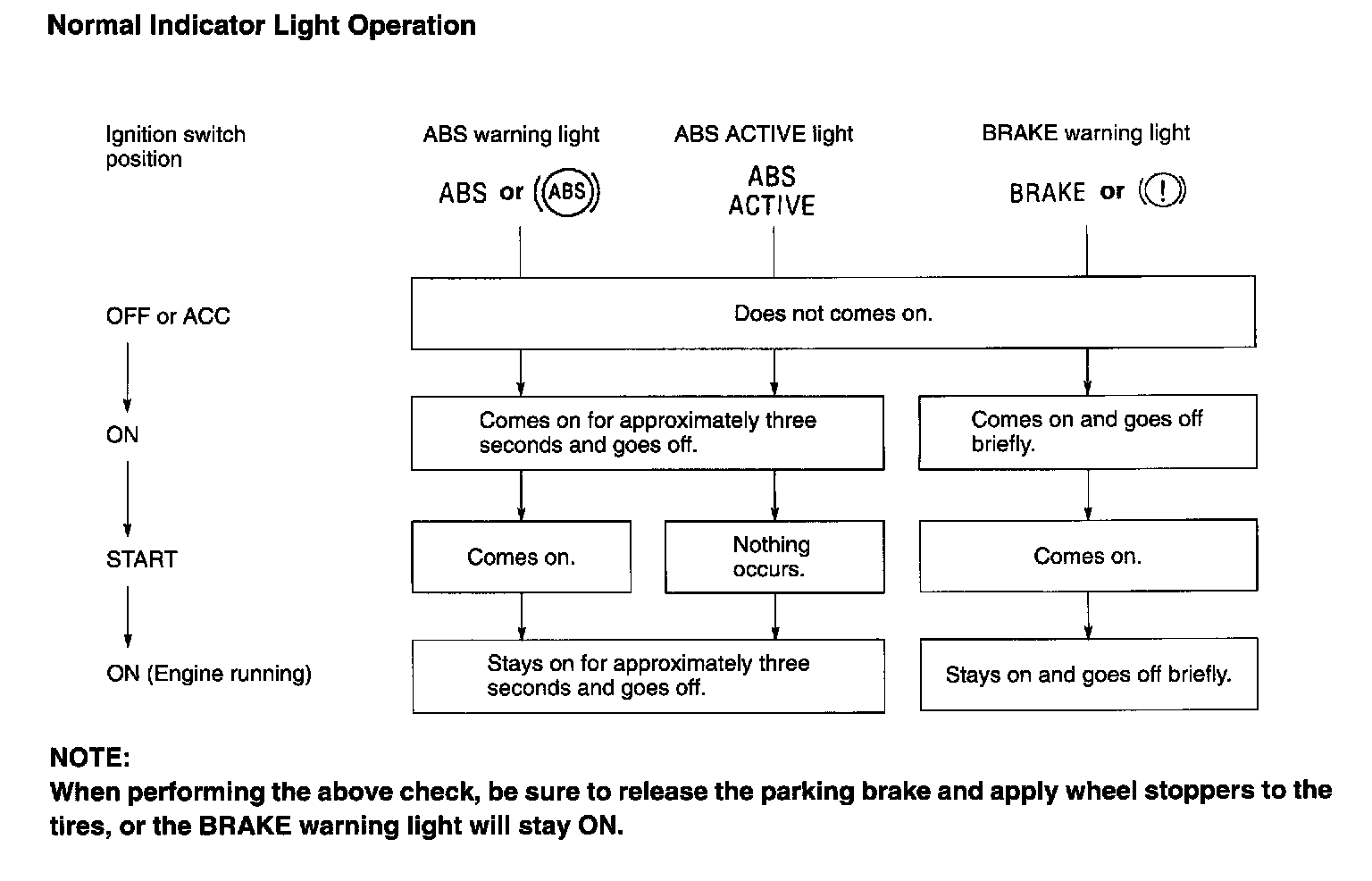
The ABS uses three lights, the amber ABS warning light, a blue ABS ACTIVE light and a red BRAKE warning light.
NOTE: When performing the above check, be sure to release the parking brake and apply wheel stoppers to the tires, or the BRAKE warning light will stay ON.
INITIALIZATION
During initialization, the EBCM will not only perform self-diagnostics, but will also verify motor, modulator, solenoid, relay and indicator light operation to ensure all components are functioning properly. If the EBCM detects a malfunction in either itself or other ABS components, it will store a diagnostic trouble code (DTC) and illuminate the "ABS" warning light if applicable.
The "ABS" and "ABS ACTIVE" warning lights will be illuminated for about three seconds when the ignition switch is first turned to "ON." A slight mechanical noise may be heard during system initialization. This is a normal occurrence - it is the result of the hydraulic modulator pistons returning to their upmost (or home) position. System initialization will occur when the vehicle speed reaches approximately 5 km/h (3 mph). If the driver has their foot on the brake pedal during system initialization, they may feel a slight pedal bump. When this occurs, system initialization is interrupted.