Shift Interlock: Description and Operation
GENERAL DESCRIPTION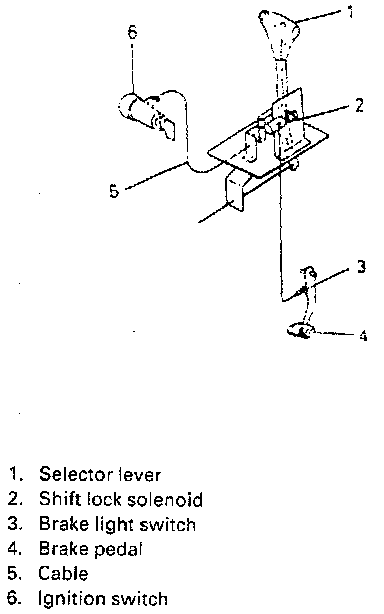
This system consists of shift lock solenoid control system and interlock cable control system.
The shift lock solenoid control system is so designed that the selector lever can not be shifted from "P" range position unless the ignition switch is turned ON and the brake pedal is depressed. And the interlock cable control system is so designed that the selector lever cannot be shifted from "P" range position unless the ignition switch is turned to "ACC" or "ON" position. Also, the ignition key cannot be pulled out of the key slot unless the selector lever is in "P" range.
OPERATIONS
SHIFT LOCK SOLENOID CONTROL
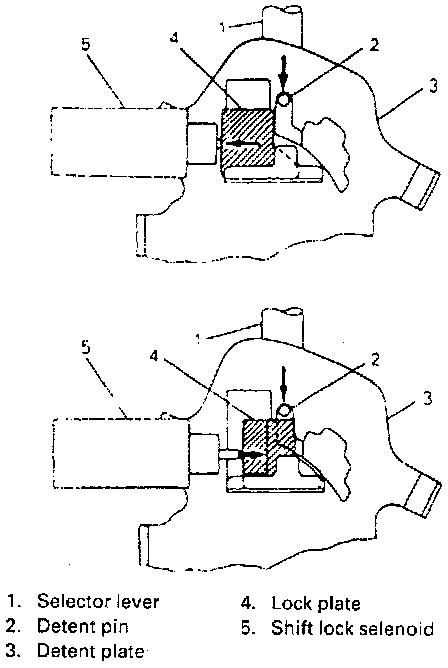
When the selector lever is in "P" range, the ignition key position is "ON" and depressing the brake pedal cause the electric current to flow to the solenoid. As the lock plate is drawn toward the solenoid in this state, it frees the detent pin, which then allows the selector lever to be shifted from "P" range to any other position.
Even when the selector lever is in "P" range, if the ignition key position is "LOCK" or "ACC" or the brake pedal is not depressed, the electric current does not flow to the solenoid.
In this state, the lock plate is pushed away from the solenoid by spring force and it obstructs the detent pin movement. Thus the selector lever button does not work even when pressed and the selector lever shift is prevented.
SHIFT LOCK SOLENOID MANUAL RELEASE
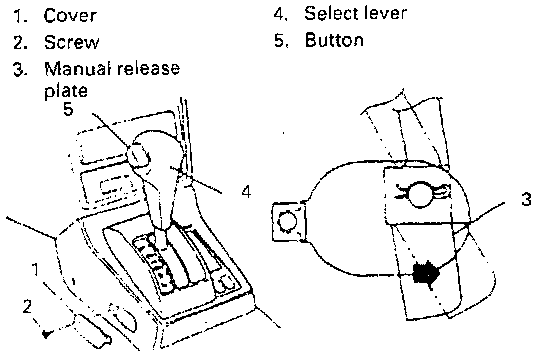
As an auxiliary device, a shift lock release is provided.
Without using brake pedal, shift lock can be moved by the manual release plate. (To shift the selector lever from "P" range to any other position, turn the ignition switch to "ACC" or "ON" position.)
INTERLOCK CABLE OPERATION
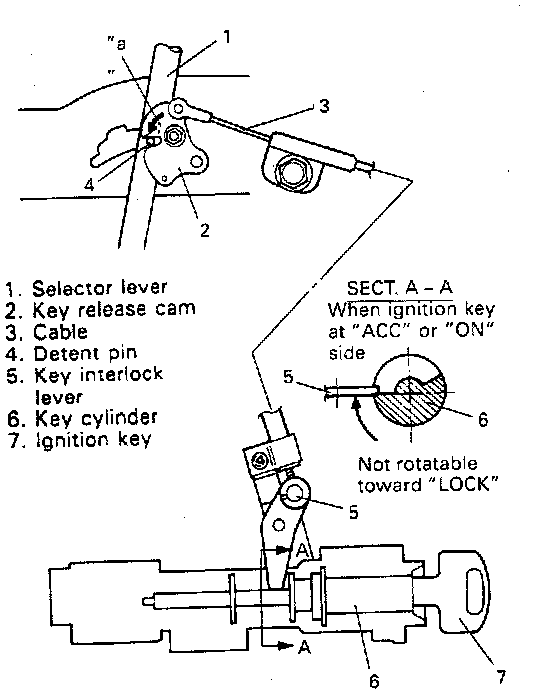
1. How ignition key is locked
When the selector lever is shifted to any other range than "P" (i.e., R. N. D, 2, L), the key release cam turns in "a" direction as shown in figure.
This means that the cable connecting the key release cam and the key interlock lever is not pushed and therefore, the key interlock lever is pushed into the key cylinder due to cable force and thus the ignition key is locked. It is impossible to turn the ignition key toward "LOCK" position when it is at "ON" position.
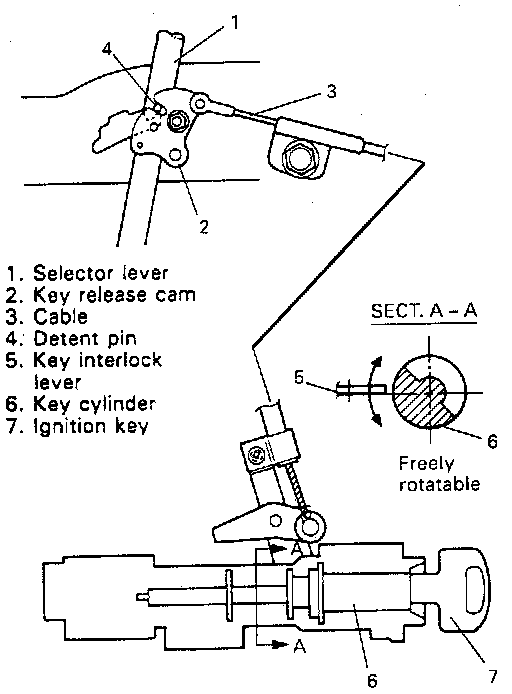
2. How ignition key is released
When the selector lever is shifted to "P" range and released shift knob button, the key release cam turned by the select lever (detent pin) pushes the cable which then pushes key interlock lever out of the key cylinder. Then the key cylinder is allowed to rotate freely and so is the ignition key in it.