Test A-3: Pcm Power & Ground Circuit Check/Engine No Start
- Observe main relay (located behind center of instrument panel) while cycling ignition switch from ON to OFF position. If no sound is heard at relay, go to next step. If sound is heard at relay, turn ignition off. Disconnect PCM harness connectors. If equipped with 3-speed automatic or manual transmission, go to step 6). If equipped with 4-speed automatic transmission, go to step 7).
- Turn ignition off. Remove main relay. Using DVOM, measure resistance between relay terminals No. 1 and 3. See Fig 1
and Fig 2
. On models produced in Japan, resistance should be 61-72 ohms. On models produced in Canada, resistance should be 79-95 ohms. Nation of manufacture is indicated by first 3 digits of VIN code. Replace relay if resistance is not as specified. If resistance is as specified, go to next step.
- Using DVOM, ensure continuity is not present between relay terminals No. 2 and 4. Using fused jumper wires, apply battery voltage across relay terminals No. 1 and 3. Ensure continuity is present between relay terminals No. 2 and 4. Replace relay if continuity is not as specified. If continuity is as specified, go to next step.
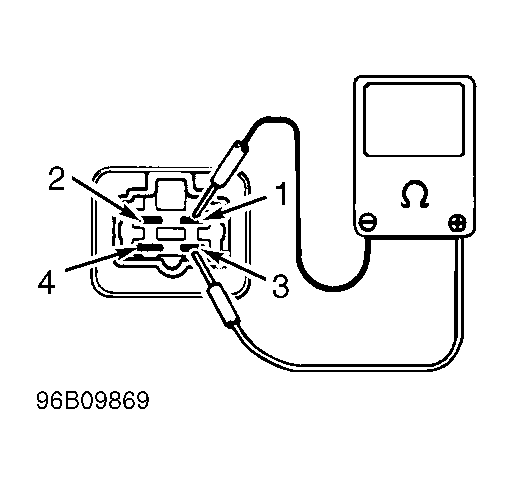 Courtesy of SUZUKI OF AMERICA CORP.
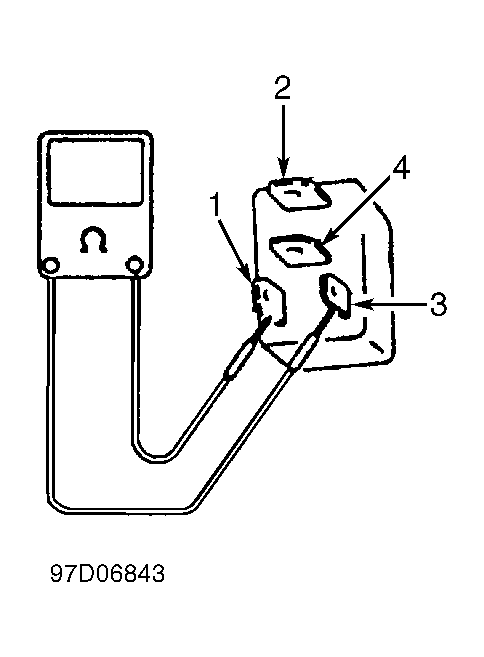 Courtesy of SUZUKI OF AMERICA CORP.
- Check condition of fuse No. 7 (15-amp), located in engine compartment relay/fuse box. If fuse is blown, check for a short circuit and repair as necessary. If fuse is okay, go to next step.
- Turn ignition off. Disconnect PCM harness connectors. Reinstall main relay. Turn ignition on. On models equipped with 3-speed automatic or manual transmission, measure voltage between ground and terminal No. 10 (Blue wire) at 22-pin PCM harness connector. On models equipped with 4-speed automatic transmission, measure voltage between ground and terminal No. 1 (Blue wire) at 26-pin PCM harness connector. If voltage is 10-14 volts, go to next step. If voltage is not as specified, repair open in Black/Red wire between fuse No. 7 (15-amp) and main relay, or open in Blue wire between main relay and PCM. Retest system.
- Connect a fused jumper wire between ground and terminal No. 10 (Blue wire) at 22-pin PCM harness connector. Turn ignition on. Using DVOM, measure voltage between ground and terminals No. 12 and 13 (Blue/Black wires) at 22-pin PCM harness connector. If voltage is 10-14 volts, go to step 8). If voltage is not as specified, repair open in Black/Red wire between fuse No. 7 (15-amp) and main relay, or open in Black/Blue wire between PCM and main relay. Retest system.
- Connect a fused jumper wire between ground and terminal No. 1 (Blue wire) at 26-pin PCM harness connector. Turn ignition on. Using DVOM, measure voltage between ground and terminals No. 3 and 16 (Blue/Black wires) at 26-pin PCM harness connector. If voltage is 10-14 volts, go to next step. If voltage is not as specified, repair open in Black/Red wire between fuse No. 7 (15-amp) and main relay, or open in Black/Blue wire between PCM and main relay. Retest system.
- Check for an open in Black/Green, Black/Blue or Black/Orange wires (ground circuits). Repair as necessary. If ground circuits are okay, replace PCM and retest system.