Exhaust Gas Recirculation: Description and Operation
The Exhaust Gas Recirculation (EGR) system controls Nitrous Oxide ((NOx) emissions. Metered amounts of exhaust gases are recirculated back into the combustion chamber to mix with the air/fuel charge. The combustion chamber temperature is reduced lowering NOx emissions.The EGR system is enabled only during part throttle modes when the engine is warm and stabilized. The Throttle Position (TP) sensor indicates part throttle, and Engine Coolant Temperature (ECT) sensor indicates a warm engine. The Powertrain Control Module (PCM) controls EGR function necessary to avoid driveability concerns during idle and maximum power demands. The PCM compensates for changes in the air/fuel ratio when EGR gases are introduced.
Pressure Feedback EGR (PFE) System:
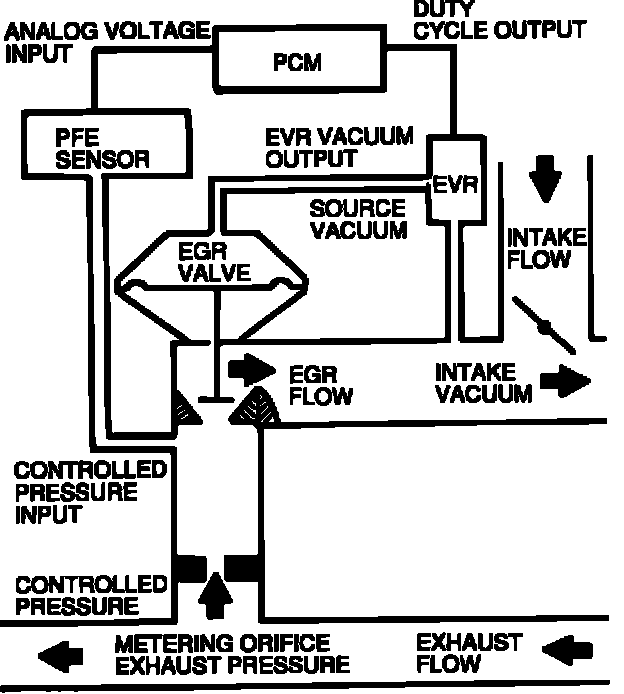
The Pressure Feedback EGR (PFE) system is a subsonic closed loop EGR system controlling EGR flow rate by monitoring exhaust pressure drop across a remotely located sharp edged orifice. The system uses a pressure transducer/sensor sending a return analog voltage signal to the PCM. Controlled pressure is varied by valve modulation using vacuum output of the EGR Vacuum Regulator (EVR) solenoid.
NOTE: Other vacuum related components may be incorporated into the EGR system, depending on vehicle model and calibration.