Evaporative Emissions System: Testing and Inspection
Engine
EVAP System Troubleshooting
EVAP System Troubleshooting
Special Tools Required
*Vacuum/Pressure Gauge, 0-4 inHg 07JAZ-001000B
*Vacuum Pump/Gauge, 0-30 inHg Snap-on YA4000A or equivalent, commercially available
1. EVAP canister purge valve check (open stuck):
EVAP canister purge valve check (open stuck)
-1. Disconnect the vacuum hose (A) from the EVAP canister (B), and connect a vacuum pump/gauge, 0-30 inHg, to the hose.
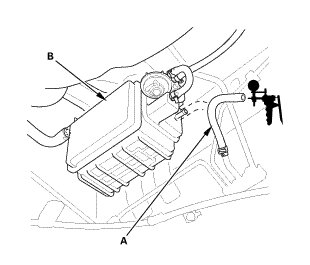
-2. Start the engine, and let it idle.
NOTE: The engine coolant temperature must be at least 149 °F (65 °C).
Is there vacuum?
-YES- Inspect the vacuum hose routing. If OK, replace the EVAP canister purge valve Service and Repair.
-NO- Go to step 2.
2. EVAP canister purge valve check (closed stuck):
EVAP canister purge valve check (closed stuck)
-1. Hold the engine speed at 3,000 rpm without load (in P or N) until the radiator fan comes on, then continue to hold the engine speed at 3,000 rpm.
Is there vacuum?
-YES- Go to step 3.
-NO- Inspect the vacuum hose routing. If OK, replace the EVAP canister purge valve Service and Repair.
3. EVAP canister check:
EVAP canister check
-1. Turn the ignition switch to LOCK (0).
-2. Reconnect the vacuum hose to the EVAP canister.
-3. Remove the fuel fill cap.
-4. Disconnect the purge air hose (A) from the EVAP canister (B), then connect a T-fitting (C) and a vacuum gauge to the hose as shown.
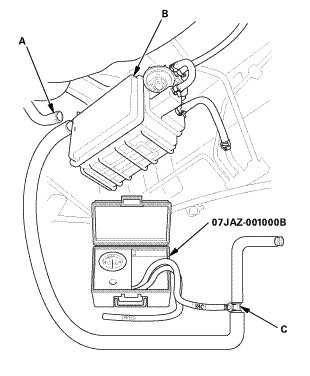
-5. Start the engine and raise speed to 3,000 rpm.
Does vacuum appear on gauge within 1 minute?
-YES- Do the EVAP two way valve test. If it is OK, evaporative emission system would be OK.
-NO- Replace the EVAP canister Service and Repair.